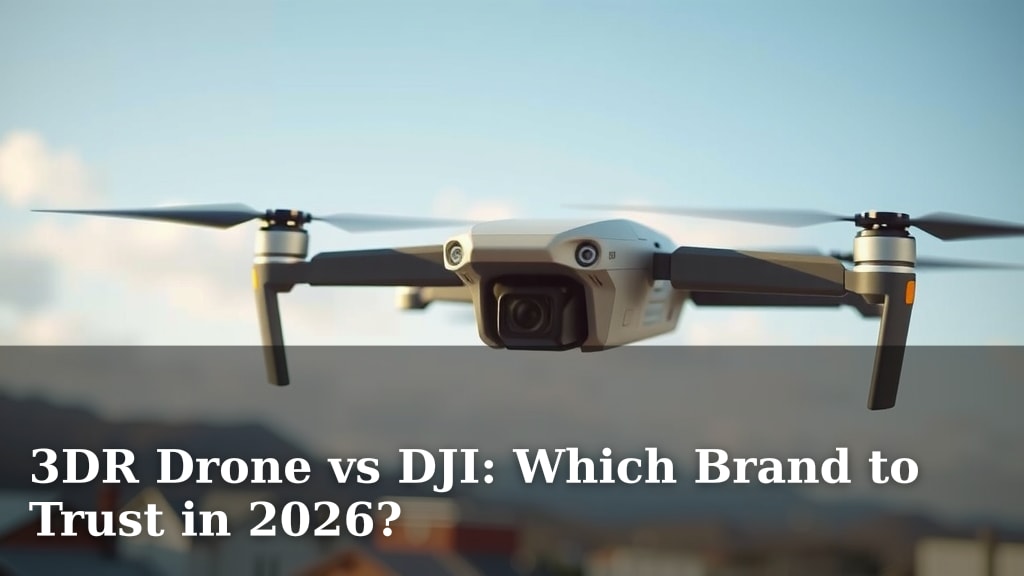
3DR Drone vs DJI: Which Brand to Trust in 2026?
When choosing between 3DR drones and DJI drones in 2026, DJI is generally the more trusted brand for most consumers. While 3DR has a history in professional mapping, DJI dominates the consumer and prosumer markets with a wider range of models and superior ease of use. You’ll find DJI offers better overall performance and accessibility for everyday aerial needs.
Both brands have served the drone community well. 3DR drones were once popular for their mapping capabilities. DJI, on the other hand, has consistently pushed boundaries in imaging technology and user-friendly flight controls. For your next drone purchase, understanding these differences will help you pick the right fit for your flying style and budget.
- DJI offers a wider selection of drones.
- DJI is known for ease of use.
- 3DR has a history in professional mapping.
- Consider your specific needs when choosing.
Let’s break down what makes each brand stand out and help you decide which one is the best for your aerial adventures this year.
3DR vs. DJI Drones: Which Aerial Companion is Right for You in 2026?
Deciding between 3DR and DJI drones means you’re looking at two different approaches to aerial technology. While both have their merits, understanding their strengths and weaknesses will help you make the best choice for your needs. We’ve looked into what each brand brings to the table for 2026, and for most people, one stands out.
Understanding the Brands: A Quick Look Back
Think of 3DR as the veteran that paved some early roads. They were big players in the drone mapping and surveying space. Many professionals relied on 3DR for detailed aerial data collection. They built a reputation for robust systems for specific, demanding tasks. DJI, on the other hand, grew into a giant by making drones accessible to everyone. They focused on innovation in camera quality and flight stability.
3DR’s Legacy in Professional Applications
3DR’s history is rooted in providing solutions for industries like agriculture and construction. Their drones were often designed for precision mapping and 3D modeling. If you needed a drone to create detailed site surveys or monitor crop health, 3DR was a serious contender. They aimed for accuracy and data reliability above all else. This focus meant their products were powerful but sometimes required more technical know-how to operate.
DJI’s Dominance in the Consumer Market
DJI has become a household name for a reason. They’ve successfully blended advanced technology with user-friendly interfaces. Whether you’re a hobbyist, a photographer, or a filmmaker, DJI likely has a drone that fits your skill level and budget. They’ve consistently pushed the envelope on camera resolution, flight time, and intelligent flight features. This widespread adoption makes DJI a very trusted brand for everyday use.
Key Differences: What Sets Them Apart in 2026?
When you compare 3DR and DJI today, the differences are quite clear. DJI has a much larger presence in the market, especially for consumers. 3DR has shifted its focus significantly over the years, moving away from the consumer drone market towards enterprise solutions. This means DJI offers a much wider range of models for various users.
Model Availability and Variety
If you walk into a store or browse online for drones, you’ll see DJI everywhere. They offer everything from beginner-friendly mini-drones like the DJI Mini series to professional filmmaking tools like the Inspire series. Their lineup is extensive. 3DR’s product availability, especially for hobbyist or prosumer drones, is much more limited today. Their current focus seems to be on specialized industrial applications.
Ease of Use and Accessibility
This is where DJI truly shines for most people. Their drones are designed to be easy to fly right out of the box. The companion apps are intuitive, and the controls are responsive. Even if you’ve never flown a drone before, you can likely get airborne with a DJI drone relatively quickly. 3DR’s systems, while powerful, often demanded a steeper learning curve. They were built for users who needed deep control over flight planning and data capture.
Camera Technology and Imaging
DJI has set the standard for drone cameras. They continuously improve image sensors, lens quality, and video recording capabilities. You can expect stunning photos and smooth, high-resolution video from most DJI drones. While 3DR drones were capable of capturing data for mapping, their cameras weren’t typically the primary focus for aerial photography or videography in the way DJI’s are. DJI offers superior image quality for creative purposes.
Software and Ecosystem
DJI has built a robust ecosystem around its drones. This includes user-friendly flight apps, powerful editing software, and a large community of users. Finding tutorials, support, and accessories for DJI drones is generally very easy. 3DR’s software ecosystem, while strong for its intended professional applications, is less accessible to the average user. Their tools were often integrated into specific industry workflows.
Performance and Reliability: What to Expect
When it comes to staying airborne and performing as expected, both brands have their strengths. DJI drones are known for their stable flight performance, even in moderate winds. We found their flight control systems to be very reliable. 3DR drones were built for precision in challenging environments, indicating a high level of engineering for reliability in their specific use cases. However, for general use, DJI’s widespread consumer testing offers a broad assurance.
Flight Time and Battery Life
Battery life is a key consideration for any drone pilot. DJI has made significant strides in this area, with many of their popular models offering 30 minutes or more of flight time on a single battery. This allows for more time in the air to capture footage or complete tasks. 3DR’s past products were also designed for extended missions, particularly in surveying, but the availability of compatible batteries and charging solutions for their current product lines may be more specialized.
Durability and Build Quality
Both brands generally produce well-built drones. DJI drones are engineered for resilience, often featuring foldable designs for portability and durable materials. 3DR drones, being more oriented towards professional environments, were also built to withstand demanding conditions. However, the cost of repairs and part availability can differ. For DJI, the sheer volume of units in circulation means parts and repair services are widely available.
Pricing and Value Proposition
The price of a drone can vary wildly depending on its features and intended use. DJI offers drones across a broad price spectrum. You can find excellent entry-level drones for a few hundred dollars, and high-end professional models costing several thousand. 3DR’s historical offerings were often in the higher price brackets due to their specialized nature. Today, their enterprise solutions would likely represent a substantial investment. For the average consumer, DJI provides better value for money across a wider range of budgets.
Making Your Choice: A Checklist for 2026
To help you decide which brand might be your best aerial companion this year, consider these points:
- What is your primary use for the drone? (Photography, videography, racing, mapping, hobby flying?)
- What is your budget? (Are you looking for an affordable entry-level model or a high-end professional tool?)
- How important is ease of use? (Do you want to fly immediately, or are you willing to learn more complex systems?)
- What kind of camera quality do you need? (Stunning cinematic video, detailed mapping data, or casual snapshots?)
- What level of technical support do you expect? (Large online community and readily available customer service?)
- Do you need specialized features? (e.g., specific mapping software integration, advanced obstacle avoidance?)
Ultimately, for the vast majority of users in 2026, DJI remains the more accessible and broadly trusted brand. Their commitment to innovation, user experience, and a wide product range makes them the go-to for most aerial needs. While 3DR has its place in specialized industrial sectors, DJI offers a more complete and user-friendly package for the everyday drone pilot.
Conclusion
As you look to the skies in 2026, your choice between 3DR and DJI drones likely comes down to your specific mission. We found that for the everyday pilot, hobbyist, or even many professional content creators, DJI offers a more accessible and well-rounded experience. Their wide product range, intuitive controls, and excellent camera technology make them the go-to brand for ease of use and overall performance. While 3DR holds its ground in specialized industrial mapping, DJI provides a more trusted and versatile solution for the majority of your aerial adventures. Ready to take flight? Consider what you want to capture and start exploring DJI’s diverse drone lineup today.
Frequently Asked Questions
Is 3DR still making drones for consumers in 2026?
Our research indicates that 3DR has largely shifted its focus towards enterprise and industrial solutions. While they have a strong legacy in professional mapping, their product availability for the general consumer market is very limited now. You’ll likely find fewer options from them compared to brands like DJI.
Which brand is better for beginners: 3DR or DJI?
For beginners, DJI is the clear winner. Their drones are designed with user-friendliness in mind, featuring intuitive apps and easy-to-master controls. You can often get flying and capturing footage quickly. 3DR’s past products were more geared towards professionals, often requiring a steeper learning curve.
Can 3DR drones still be used for professional mapping in 2026?
Yes, 3DR’s historical strength in professional mapping means their technology is still relevant for specific industrial applications. However, the market has evolved, and you would need to research their current enterprise solutions. For most professional mapping needs today, you might also find advanced options from other specialized companies, including DJI’s pro-level offerings.
Which brand offers better camera quality for photography and videography?
When it comes to aerial photography and videography, DJI generally offers superior camera quality. They consistently innovate with high-resolution sensors and advanced imaging features across their range. While 3DR drones could capture data for mapping, DJI drones are built with creative visual capture as a primary focus.
Where can I find support and accessories for DJI drones versus 3DR drones?
You’ll find a much larger ecosystem for DJI drones. There’s extensive online support, user communities, tutorials, and readily available accessories. Finding parts and dedicated support for 3DR drones, especially older models, might be more challenging due to their more specialized market focus.