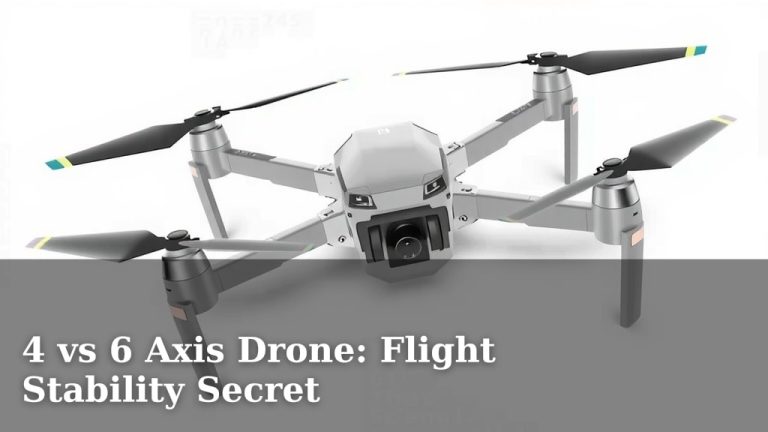
4 Axis vs 6 Axis Drone: Stability and Control Explained
If you’re diving into the world of drones, you’ve probably stumbled across terms like “4-axis” and “6-axis” and wondered what the heck they actually mean. Don’t worry—you’re not alone. Most beginners find themselves confused by this technical jargon, but here’s the thing: understanding the difference between these two types could completely change your drone flying experience.
Think of drone axes like the directions your body can move. Just as you can move forward, backward, left, right, up, and down, drones operate along similar principles. The number in front of “axis” tells you how many of these movements your drone can independently control. Sounds simple, right? Well, it gets more interesting when you start flying.
What Exactly is an Axis on a Drone?
Before we jump into the specifics of 4-axis versus 6-axis drones, let’s establish what we mean by an axis. An axis is essentially a direction of movement or rotation. In drone terminology, we’re talking about how a drone can move through three-dimensional space.
Imagine a stick going through the center of a sphere. That stick represents an axis, and the drone can rotate around it. Every drone operates along three primary rotational axes: roll, pitch, and yaw. These are the fundamental movements that allow a drone to tilt left and right, tilt forward and backward, and spin clockwise or counterclockwise.
The Three Primary Rotational Movements
Let me break down these three movements for you:
- Roll: This is when your drone tilts side to side. Imagine leaning your body left or right—that’s roll.
- Pitch: This movement tilts the drone forward and backward. Think of nodding your head up and down.
- Yaw: This is when the drone spins around its vertical axis. Picture yourself spinning in a chair—that’s yaw.
These three movements form the foundation of drone control, and they’re essential for basic flight. But here’s where things get interesting: beyond these rotational movements, drones can also move laterally through space—up, down, forward, backward, left, and right. These are called translational movements, and they’re what separate a 4-axis drone from a 6-axis one.
Understanding 4-Axis Drones
A 4-axis drone is the entry-level warrior of the drone world. These machines can control four different movements: the three rotational axes we just discussed (roll, pitch, and yaw), plus one translational movement—vertical altitude control.
What does this mean in practical terms? With a 4-axis drone, you can tilt it in any direction, spin it around, and move it up or down. However, there’s a catch: when you want to move the drone horizontally—forward, backward, left, or right—you have to tilt the drone and let gravity and the tilt angle handle the movement. It’s like trying to move forward in a car by only tilting the steering wheel; you have to rely on the vehicle’s momentum and angle to achieve the lateral movement.
The Strengths of 4-Axis Drones
You might be thinking, “Well, that sounds limiting.” And you’d be right in some ways, but 4-axis drones have significant advantages:
- Affordability: These drones are considerably cheaper than their 6-axis counterparts. You’re looking at a price tag that won’t make your wallet weep.
- Simplicity: With fewer control inputs to manage, 4-axis drones are easier to learn on. Perfect for someone just getting their feet wet in drone flying.
- Speed: Many 4-axis drones are surprisingly fast. Since they rely on tilting to move horizontally, they can achieve impressive velocities quickly.
- Durability: Fewer moving parts and simpler mechanisms mean these drones often hold up better to crashes and rough handling.
If you’re buying your first drone or you’re looking for something to do some quick aerial photography with minimal fuss, a 4-axis drone might be your perfect match.
The Limitations You’ll Face
Now, let’s be honest about the drawbacks. The lack of independent lateral movement control creates some real challenges:
- Limited Stability in Wind: When the drone tilts to move forward, it becomes more susceptible to wind interference. In windy conditions, maintaining a stable position becomes tricky.
- Difficult Hovering: Getting a 4-axis drone to hover perfectly still in all directions requires constant pilot adjustment. It’s like trying to balance on a tightrope while riding a unicycle.
- Less Precise Framing: For photography and videography, the inability to move the camera position independently from the tilt angle limits your compositional options.
- Reduced Control in Complex Environments: In confined spaces or near obstacles, the limited control precision becomes a genuine liability.
Diving Into 6-Axis Drones
Now we’re talking about the sophisticated cousin in the drone family. A 6-axis drone can control all the rotational movements we discussed, plus it has independent control over lateral movements in all directions. This means you can move the drone forward, backward, left, right, up, and down completely independently of the drone’s orientation.
Think of a 6-axis drone like a helicopter. A helicopter pilot can hover in place, move forward, move backward, move left, move right, move up, and move down—all while maintaining a level orientation. That’s precisely what a 6-axis drone offers you.
The Remarkable Advantages of 6-Axis Control
The additional control offered by a 6-axis system opens up a world of possibilities:
- Superior Stability: The independent control over lateral movements allows the drone to maintain a steady position even in windy conditions. The drone can compensate for wind without tilting excessively.
- Precise Hovering: A 6-axis drone can hold its position with impressive accuracy. This stability is like the difference between standing on solid ground versus standing on a moving train.
- Professional-Grade Footage: For photography and videography, the ability to move the camera without changing the frame’s angle is invaluable. You can pan, track, and reposition with cinematic precision.
- Complex Maneuvers: 6-axis drones can perform intricate movements that 4-axis drones simply cannot. Think of sideways movements, diagonal approaches, and smooth orbital shots.
- Safer Operation: The enhanced control makes these drones safer in complicated environments. You have more options to avoid obstacles and recover from unfavorable positions.
If you’re serious about aerial photography, videography, or just want the best flying experience possible, a 6-axis drone is genuinely the way to go.
The Trade-Offs to Consider
Of course, that extra capability comes with its own set of considerations:
- Higher Cost: 6-axis drones are significantly more expensive. You’re investing in advanced technology, and that investment shows in the price tag.
- Increased Complexity: More control options mean a steeper learning curve. You’ll need to invest time in mastering the controls.
- Battery Consumption: The additional motors and more active stabilization systems consume more battery power. Your flight time might be reduced compared to simpler 4-axis models.
- Maintenance: More sophisticated electronics and moving parts mean more potential points of failure and higher maintenance costs.
Side-by-Side Comparison of Stability
When it comes to stability, these two drone types operate in fundamentally different ways. Let’s compare them in realistic scenarios:
Stability in Calm Conditions
In perfectly calm conditions, both drone types can maintain reasonable stability. However, a 6-axis drone will always have a slight edge because it can make micro-adjustments in all directions without tilting. A 4-axis drone, meanwhile, must tilt to make lateral adjustments, which introduces more complex movement patterns.
Stability in Windy Conditions
Here’s where the differences become obvious. Imagine you’re trying to hold a camera still while someone pushes you from the side. You’d compensate by leaning, right? That’s what a 4-axis drone does. It tilts to fight the wind. A 6-axis drone, however, is like being inside a stable platform that can move in any direction without tilting. It can push back against the wind directly, resulting in much cleaner, more stable footage and more predictable flight behavior.
Stability for Professional Footage
For anyone trying to capture smooth, professional-looking video, a 6-axis drone is transformative. The consistent camera orientation combined with precise positioning creates that cinematic quality that viewers expect from professional content. A 4-axis drone, while capable, will always produce footage with more subtle tilting and angle changes, even if you’re trying to keep the camera level.
Control Precision Explained
Control precision is another critical factor that separates these drone types. When we talk about precision, we’re discussing how accurately you can position your drone and how smoothly it responds to your inputs.
Response Speed and Smoothness
A 6-axis drone typically offers faster response times and smoother movement because it can make direct adjustments in any direction. It doesn’t have to calculate the best tilting angle to achieve lateral movement; it simply moves in the desired direction.
A 4-axis drone, conversely, has to interpret lateral inputs as tilt commands. This creates a slight delay and introduces more complex movement patterns that can feel less responsive.
Precision in Confined Spaces
Flying near obstacles requires pinpoint accuracy. In tight spaces, a 6-axis drone’s ability to move in any direction without tilting dramatically is a game-changer. You can position the drone exactly where you need it, move it backward without spiraling, and navigate through narrow passages with confidence.
A 4-axis drone requires more space to maneuver because its movement patterns are less predictable, particularly when you need to move in multiple directions simultaneously.
Which One is Right for You?
Choosing between a 4-axis and 6-axis drone really depends on your specific needs and circumstances. Let me help you think through this decision:
Choose a 4-Axis Drone If:
- You’re a complete beginner wanting to learn drone flying without overwhelming complexity.
- Your budget is limited, and you need an affordable entry point into the hobby.
- You primarily want to fly for fun in open spaces like parks or fields.
- You enjoy racing or speed-focused flying activities.
- You don’t need high-quality cinematic footage.
Choose a 6-Axis Drone If:
- You want to capture professional-quality aerial photography or videography.
- You plan to fly in challenging weather conditions or windy environments.
- You need to navigate complex environments with obstacles.
- You want the best possible flying experience with maximum control.
- You’re willing to invest in quality equipment and are committed to the hobby.
Real-World Performance Differences
Let’s talk about how these differences play out in actual flying situations. Imagine you’re trying to capture a smooth video pan around a building. With a 4-axis drone, you’d have to coordinate tilting movements while ascending, which creates complex motion that’s difficult to smooth out in post-production. With a 6-axis drone, you can maintain a perfectly level camera angle while moving around the building, resulting in footage that looks professionally captured.
Or consider flying in a gusty wind. Your 4-axis drone would be constantly tilting to fight the wind, making your footage look jittery and unstable. A 6-axis drone would steadily push against the wind with its independent lateral controls, maintaining a stable platform for your camera.
The Technology Behind the Difference
Understanding the technology helps explain why these differences exist. A 4-axis drone typically uses four motors arranged in a plus or X configuration. These motors control the three rotational movements and vertical lift.
A 6-axis drone usually has six motors arranged in a hexagonal pattern. Three motors on one side and three on the other allow for independent control of all six degrees of freedom. The flight controller calculates the precise motor speed for each rotor to achieve the desired movement in any direction.
This sophisticated system requires more computing power, more sensors, and more advanced algorithms. That’s why 6-axis drones are more expensive and complex—they’re genuinely more technologically sophisticated.
Budget Considerations and Value
Let’s talk money. A decent entry-level 4-axis drone might run you anywhere from fifty to three hundred dollars depending on the brand and features. You’re getting something affordable that allows you to learn and have fun.
A quality 6-axis drone typically starts around three hundred dollars for basic models and can easily exceed two thousand dollars for professional-grade systems. The jump in price reflects the jump in capability and technology.
Here’s the real question: Is that additional capability worth the extra cost for you? If you’re using the drone primarily for casual fun, probably not. If you’re thinking about this as a tool for work or a serious hobby, absolutely yes.
Future-Proofing Your Investment
One more thing to consider: the rate at which you’ll grow tired of your drone. Many people who start with a 4-axis drone quickly find its limitations frustrating and end up upgrading to a 6-axis model anyway. In some ways, spending more upfront on a 6-axis drone saves you money in the long run because you won’t need to upgrade as soon.
Think of it like buying a camera. That basic point-and-shoot might seem like a great deal until you realize you want more control and better image quality. Then you’re buying a new camera anyway.
Conclusion
The difference between 4-axis and 6-axis drones comes down to control capabilities and stability. A 4-axis drone offers affordability and simplicity with decent performance in calm conditions and open spaces. It’s perfect for beginners and casual flyers who want to dip their toes into the hobby without a significant financial commitment.
A 6-axis drone, however, delivers professional-level stability, precise control, and the capability to handle challenging environments and conditions. If you’re serious about aerial photography, videography, or simply want the best flying experience possible, a 6-axis drone is worth the investment.
The choice ultimately depends on your budget, your intended use, and how serious you are about the hobby. Honestly assess what you actually need and want to do with your drone, and let that guide your decision. Either way, you’re about to embark on an exciting journey into the world of drone flying.
Frequently Asked Questions
Can a 4-axis drone take good aerial photos?
Yes, a 4-axis drone can definitely capture decent aerial photos, especially in calm conditions and open landscapes. The limitation isn’t so much in image quality as it is in your ability to position the camera exactly where you want it. For casual photography or landscape shots, a 4-axis drone works fine. However, for professional-grade work or complex compositions, you’ll appreciate the superior control of a 6-axis drone.