Airplane vs Drone at Night: Lights, Safety & Legal Differences
Have you ever looked up at the night sky and wondered whether that moving light was an airplane or a drone? You’re not alone. With drones becoming increasingly popular and airplanes constantly flying overhead, distinguishing between the two has become a genuine concern for many people. The difference matters more than you might think, especially when it comes to safety, regulations, and what you’re legally allowed to do in your own backyard.
In this comprehensive guide, we’re going to explore everything you need to know about airplanes and drones at night. We’ll look at how to identify them, understand their lighting systems, examine the safety implications, and break down the legal requirements that govern their operation.
Understanding the Basics: What Exactly Are We Looking At?
Before we dive into the specifics of nighttime observation, let’s establish what we’re talking about. Airplanes are large, manned aircraft that operate according to strict regulations and established flight paths. Drones, on the other hand, are unmanned aerial vehicles that can range from small hobbyist devices to sophisticated commercial equipment.
The fundamental difference is that airplanes carry people and follow predetermined routes with air traffic control oversight. Drones are remote-controlled or autonomous devices that can operate more freely, though they still face increasing regulations.
Why Nighttime Identification Matters
Identifying what’s flying above you at night isn’t just curiosity—it’s a safety issue. Airplanes follow strict protocols because they’re carrying passengers. Drones operate in increasingly complex airspace, and without proper identification, confusion can lead to safety hazards. Additionally, knowing the difference helps you understand what’s legal and what isn’t in your area.
Lighting Systems: The Key to Identification
How Airplane Lights Work
Aircraft lighting is highly standardized and regulated. Think of it as a universal language in the sky. Every commercial airplane and most private aircraft must follow specific lighting requirements that haven’t changed much in decades.
Red and Green Navigation Lights
Airplanes have red and green lights on their wingtips. The red light is on the left wing, while the green light is on the right wing. These are called navigation lights or position lights, and they serve a crucial purpose: they help other pilots determine the direction the aircraft is moving. If you see red on the left and green on the right, the plane is moving toward you. This system works because pilots understand it intuitively—it’s been the standard for decades.
White Strobe Lights
You’ve definitely seen this if you’ve watched planes at night. Commercial aircraft have bright white strobe lights that flash on and off. These are extremely bright and visible from great distances, sometimes appearing almost like a beacon in the sky. The strobing effect makes them impossible to miss, and that’s exactly the point. These lights help other aircraft and ground personnel spot planes in the dark.
The Belly Light
Below the fuselage, most commercial aircraft have a white light called the belly light or landing light. When planes are preparing to land or taking off, they turn this light on. It illuminates the ground and helps the pilots see the runway, but it’s also visible from other aircraft and ground observers.
Drone Lighting Systems
Drones present a completely different lighting scenario. Most consumer drones are quite small and don’t require the same lighting systems as aircraft. However, regulations are catching up, and things are changing rapidly.
Red and Green Navigation Lights on Drones
Larger drones and those operating at night are increasingly required to have navigation lights similar to airplanes. However, these lights are much dimmer because drones are smaller and fly at lower altitudes. A drone’s red and green lights are visible from much shorter distances than airplane lights—typically a few hundred feet rather than miles.
LED Lights on Consumer Drones
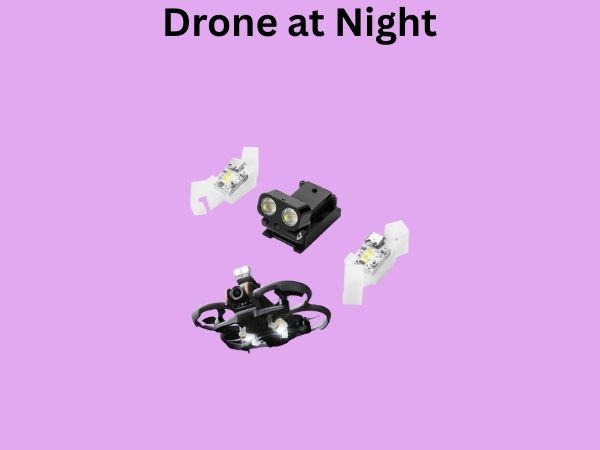
Many consumer drones come with LED lights that blink in various patterns. These serve multiple purposes: they help the operator see the drone at night, they help other people see the drone, and they create an aesthetic effect. However, these lights don’t follow the same strict standards as airplane lighting, and they’re often much dimmer and less reliable for long-distance visibility.
The Challenge with Drone Lighting
Here’s where things get tricky. Most small recreational drones fly too low to be visible from very far away, and their lights aren’t bright enough to be seen for long distances. This means that what looks like a drone to someone on the ground might actually be something else entirely, and vice versa.
Visual Characteristics: Movement and Patterns
How Airplanes Move at Night
Airplanes have specific movement patterns that make them somewhat predictable. They fly in straight lines at consistent speeds—usually between 450 and 550 miles per hour for commercial jets. Their movement is smooth and steady, without sudden changes in direction or speed.
The light pattern you see moves slowly across the sky relative to your position. If you watch an airplane for several minutes, you’ll notice it travels in a fairly straight line and the lights maintain the same relative position to each other.
How Drones Move at Night
Drones, being much smaller and more agile, can move differently. They can hover in one spot, move slowly, or change direction rapidly. However, it’s important to note that most recreational drones can’t move nearly as fast as airplanes, and their flight paths are often more erratic because they’re controlled by people on the ground who might make adjustments.
If you see something moving slowly and changing direction unexpectedly, you’re probably watching a drone. If you see something moving consistently in one direction at a relatively fast speed, it’s likely an airplane.
Altitude and Distance Clues
Understanding Flight Altitudes
The altitude at which aircraft operate tells us a lot about what we’re seeing. Commercial airplanes typically cruise between 30,000 and 40,000 feet. Private planes might fly between 5,000 and 15,000 feet. Drones, on the other hand, are limited by law and by their battery capacity.
In the United States, recreational drones are limited to 400 feet above ground level. Some commercial drones can fly higher with special waivers, but they’re still nowhere near airplane altitudes.
How Distance Affects What You See
Here’s a practical reality: the higher and farther away something is, the smaller it appears and the longer it takes to cross the sky. A commercial airplane at 35,000 feet will appear as a point of light moving slowly across your field of vision, sometimes taking several minutes to disappear below the horizon.
A drone at 400 feet will appear larger (relative to its actual size) and will move faster across your vision if it’s moving at all. The light pattern will also be different—you might see multiple lights twinkling rather than the steady, coordinated lights of an airplane.
Safety Considerations and Airspace Management
Why Airplane Safety Matters
Commercial aviation is remarkably safe, but that safety depends on precise coordination and communication. Air traffic control systems track every airplane in controlled airspace, and pilots maintain constant communication with ground control.
The risk of a drone interfering with an airplane is real, though statistically rare. A collision between a drone and an aircraft could damage the aircraft or injure people inside it. For this reason, the Federal Aviation Administration (FAA) has become increasingly strict about drone regulations.
Drone Safety and Airspace Restrictions
Drones can’t just fly anywhere. They’re restricted from flying near airports, military installations, and certain protected areas. They can’t fly over people they don’t have permission to observe, and they can’t interfere with manned aircraft.
The challenge is that not all drone operators follow these rules, and enforcement is difficult. This is why you might hear news stories about drones near airports—it’s a genuine safety concern even though the actual risk is small.
The Role of Technology in Safety
Modern technology is helping with safety in several ways. ADS-B technology broadcasts airplane positions in real-time, and many drone manufacturers are incorporating this technology into their products. Some drones now have geofencing that prevents them from flying into restricted airspace.
Additionally, radar systems and detection technology are improving to identify drones that might pose a risk. As both technologies evolve, the ability to detect and manage conflicts improves.
Legal Differences and Operational Restrictions
Airplane Operations: Strict Regulations
Airplanes operate under incredibly strict regulations. Pilots must be licensed, aircraft must pass regular inspections, and operations must follow established procedures. Commercial airlines have thousands of rules governing everything from passenger safety to fuel management.
Flying an airplane at night requires additional certifications and equipment. Night flying is more complex and requires pilots to have specific training and experience.
Drone Operations: Rapidly Evolving Rules
Drone regulations are still being developed in many countries. In the United States, the FAA has established rules for recreational drone operators and more stringent rules for commercial operations.
Recreational Drone Rules
- Drones must remain in visual line of sight of the operator
- Drones must not fly higher than 400 feet above ground level
- Drones cannot fly over people or property they don’t have permission to observe
- Drones must be registered with the FAA
- Operators must pass a test to demonstrate knowledge of regulations
Commercial Drone Rules
Commercial drone operations are more tightly regulated. Operators need a Part 107 license, which requires passing an exam and demonstrating knowledge of airspace, regulations, and safety procedures. Commercial operations can be more complex than recreational flying, but they provide important services like surveying, inspection, and aerial photography.
Nighttime Operation Rules
This is where things get particularly interesting. Commercial airplanes operate at night constantly, with specific lighting and communication protocols. Recreational drones, however, face restrictions on nighttime operation.
As of recent regulations, recreational drones cannot fly at night unless the operator has special waiver approval from the FAA. This is because nighttime operation makes it harder for drone operators to maintain visual line of sight and increases the risk of accidents.
Commercial drone operators with Part 107 licenses can operate at night under specific conditions and with proper lighting and approval. Some operations use infrared cameras or other technology to maintain awareness of the drone’s position.
Common Misconceptions About Airplanes and Drones
Myth: All Lights in the Sky Are Either Planes or Drones
This is false. The night sky contains many moving lights. Satellites, including the International Space Station, appear as bright objects moving across the sky. Helicopters, which are manned aircraft but operate differently than airplanes, also have distinctive flight patterns. Shooting stars, weather balloons, and even bright planets can be mistaken for aircraft or drones.
Myth: Drones Are Too Small to Damage Airplanes
This is dangerously incorrect. Even small drones traveling at high speeds can damage aircraft. The force of impact increases with speed, and a drone strike at altitude could be catastrophic. This is why regulations keep drones away from airplanes.
Myth: You Can Legally Fly a Drone Whenever You Want
Not true. Even recreational drone operation is regulated. You need to register your drone, pass a test, and follow specific rules about where and how you can fly. Flying a drone without following these rules can result in hefty fines.
Myth: Airplane Lights Follow a Specific Pattern That Never Varies
While airplane lighting is standardized, different aircraft types might have slight variations. Additionally, pilots can control when certain lights are on or off. For example, landing lights might be turned on only when approaching an airport. This means the light pattern you see might vary slightly depending on the aircraft type and what phase of flight the airplane is in.
How to Accurately Identify What You’re Seeing
A Practical Identification Checklist
If you’re trying to determine whether you’re seeing an airplane or drone, here’s a practical approach:
- Observe the movement: Steady and straight usually means airplane; erratic or hovering usually means drone
- Count the lights: Airplanes have a distinctive pattern of red, green, and white lights; drones often have multiple colored LEDs but without the same pattern
- Note the brightness: Airplane lights are typically very bright, especially the white strobes; drone lights are usually dimmer
- Watch the speed: Fast and consistent movement suggests an airplane; slower or variable speed suggests a drone
- Check the altitude: If it’s visible for many minutes as it crosses the sky, it’s probably an airplane; if it disappears or changes significantly in a short time, it might be a drone
Using Technology to Help Identify Aircraft
Modern technology makes identification easier. Apps like Flightradar24 show commercial aircraft in real-time with their flight paths, altitudes, and destinations. If you see something and want to know if it’s a plane, you can check these apps to see if there’s an aircraft in your area at that moment.
For drones, identification is trickier since they don’t broadcast their positions publicly for privacy reasons. However, if you see something and it matches the drone characteristics we’ve discussed, it’s probably a drone.
Weather and Environmental Factors
How Clouds and Visibility Affect What You See
Weather plays a significant role in nighttime observation. On clear nights, you can see aircraft lights from great distances. On cloudy nights, visibility is limited.
Interestingly, sometimes airplane lights reflect off clouds in ways that can make identification confusing. The light might scatter and create a glow that looks unusual. Understanding this helps prevent misidentification.
Seasonal and Atmospheric Considerations
Different times of year bring different atmospheric conditions. Pollution, humidity, and air particles all affect visibility. In areas with light pollution, it’s harder to see fainter lights, which means dimmer drone lights might not be visible while airplane lights still are.
The Future of Airplanes and Drones
Emerging Technologies and Regulations
The landscape of aviation is changing. Electric aircraft are being developed, which might have different lighting systems. Drones are becoming more sophisticated, with better communication systems and safety features.
Regulations will continue to evolve as technology develops. Remote identification requirements for drones are becoming more common, which will make it easier to track and identify drones in the sky.
Urban Air Mobility and What It Means
One of the most interesting developments is the concept of urban air mobility—essentially, flying taxis and other aircraft operating at lower altitudes in populated areas. As this technology develops, the skies will become